
Fact Sheets on Moose Migration
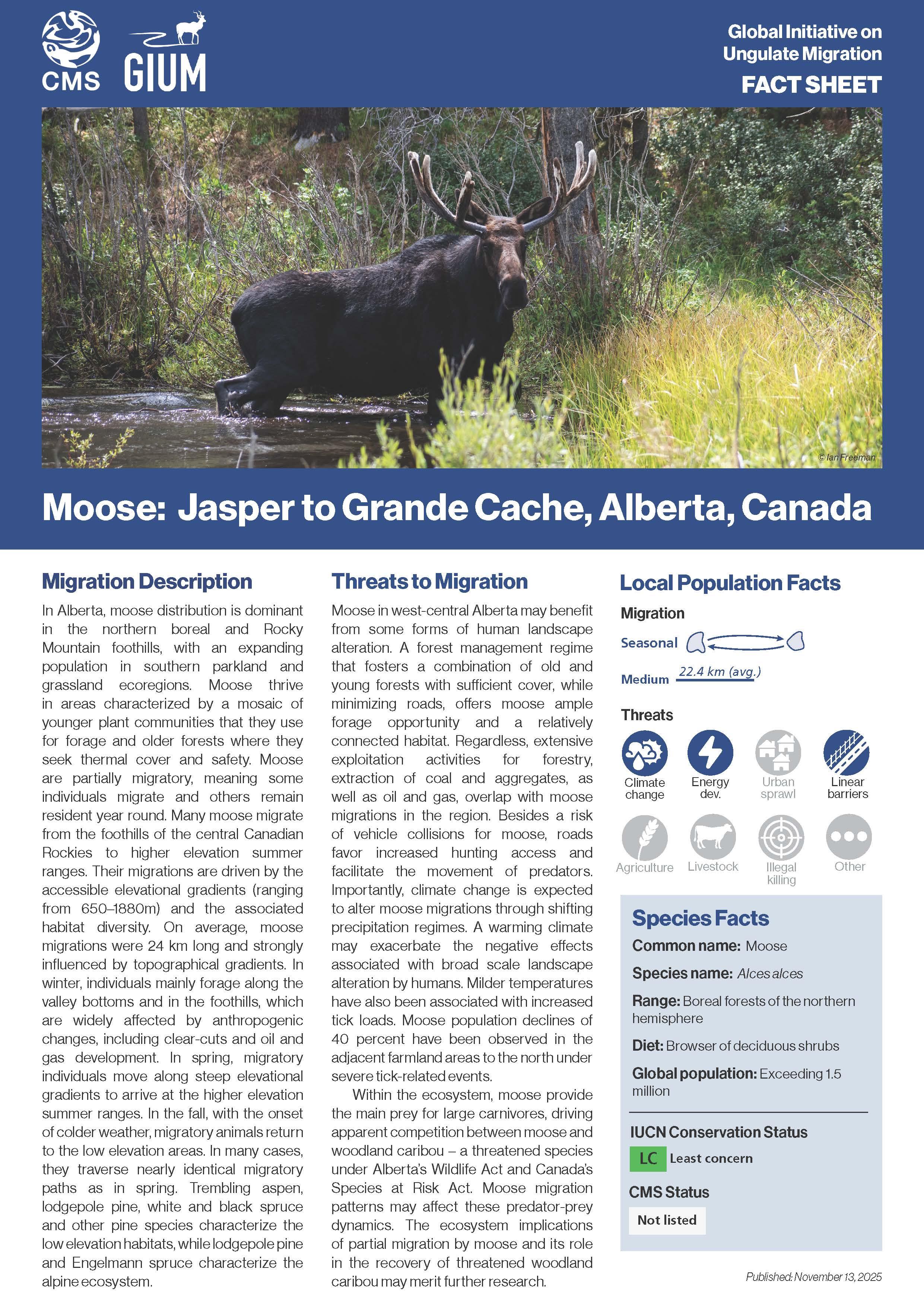
Alberta, Canada
In Alberta, moose distribution is dominant in the northern boreal and Rocky Mountain foothills, with an expanding population in southern parkland and grassland ecoregions. Moose thrive in areas characterized by a mosaic of younger plant communities that they use for forage and older forests where they seek thermal cover and safety. Moose are partially migratory, meaning some individuals migrate and others remain resident year round. Many moose migrate from the foothills of the central Canadian Rockies to higher elevation summer ranges. Their migrations are driven by the accessible elevational gradients (ranging from 650–1880m) and the associated habitat diversity. On average, moose migrations were 24 km long and strongly influenced by topographical gradients.
Northern Scandinavian Mountains, Sweden
Following a population bottleneck due to overhunting in the early 1900s, moose populations have rebounded across Sweden. Sweden is now home to the densest population of moose in the world. Moose in Sweden are partially migratory, with some animals remaining resident year round and others making migrations up to 200 km long. Their migration distance and duration vary in response to weather conditions, forage availability and the latitudinal or east-west gradients they travel across. Their migration distance and duration vary in response to weather conditions, forage availability and the latitudinal or east-west gradients they use to travel. The onset of spring migration is typically consistent across individuals in the same area, whereas fall migration is a more protracted process with moose leaving summer ranges at different times.
Northern Inland, Sweden
In Sweden’s mountainous interior, strong seasonality characterizes the moose’s migratory range. Here, many moose migrate long distances, often traveling northwest from their winter range to their summer ranges. Some animals make altitudinal migrations. Migrants typically move between coniferous forests and highly productive deciduous forests in the mountains in the summer.
Haparanda-Kalix Archipelago, Sweden
Along Sweden’s northern archipelago, moose swim among small islands in the Baltic Sea. Most moose remain residents, while the migratory animals fall into two groups – one that utilizes different islands and parts of the mainland during different times of the year and a second one that migrates from the mainland along the coastline in winter north into the interior during summer. Migration routes are typically specific to the individual and are relatively predictable from year to year.
Västerbotten Coastal Area, Sweden
In Sweden's boreal coastal-inland, strong seasonality characterizes the moose’s migratory range. The further inland they are, moose experience more seasonal conditions, and migrate moderate distances in variable directions. Moose near the coastline migrate north-west during spring, while inland migrants may travel in any direction. Migration routes are typically specific to the individual and are relatively predictable from year to year.
Central Sweden
In the Sweden’s central interior, long snowy winters (Nov.-April) and short summers (June-Aug.) characterize the moose’s migratory range. Here, about half of the population is migratory. Except for one large river, the habitat is relatively homogenous. Migration routes are typically specific to the individual and are relatively predictable from year to year, and travel directions vary.