
CMS and the Agreement on the Conservation and Sustainable Use of Marine Biological Diversity of Areas beyond National Jurisdiction (BBNJ Agreement)
What is the BBNJ Agreement?
The Agreement under the United Nations Convention on the Law of the Sea on the Conservation and Sustainable Use of Marine Biological Diversity of Areas beyond National Jurisdiction (BBNJ Agreement) was adopted on 19 June 2023. The Agreement is the third implementing agreement to the United Nations Convention on the Law of the Sea (UNCLOS). It entered into force 120 days after the date of deposit of the 60th instrument of ratification, approval, acceptance or accession. That instrument was deposited on 19 September 2025, and the Agreement entered into force on 17 January 2026, a major milestone in international cooperation and biodiversity conservation.
The scope of work of the BBNJ Agreement
61% of the ocean is considered Areas Beyond National Jurisdiction (ABNJ), meaning that these areas do not fall under the national jurisdiction of any country. UNCLOS sets out the legal framework applicable to these areas, including the rights and obligations of States in those areas. Although ABNJ form important habitats for a wide variety of species and provide crucial ecological functions, only 1.5% of the area is protected. The BBNJ Agreement was adopted to improve the conservation and sustainable use of marine biological diversity in these areas beyond national jurisdiction.
Specifically, the BBNJ Agreement provides a framework for:
- ensuring equitable access and benefit-sharing of marine genetic resources;
- establishing marine protected areas (MPAs) in international waters;
- conducting environmental impact assessments for activities in ABNJ; and
- supporting capacity building and technology transfer, especially for developing countries.
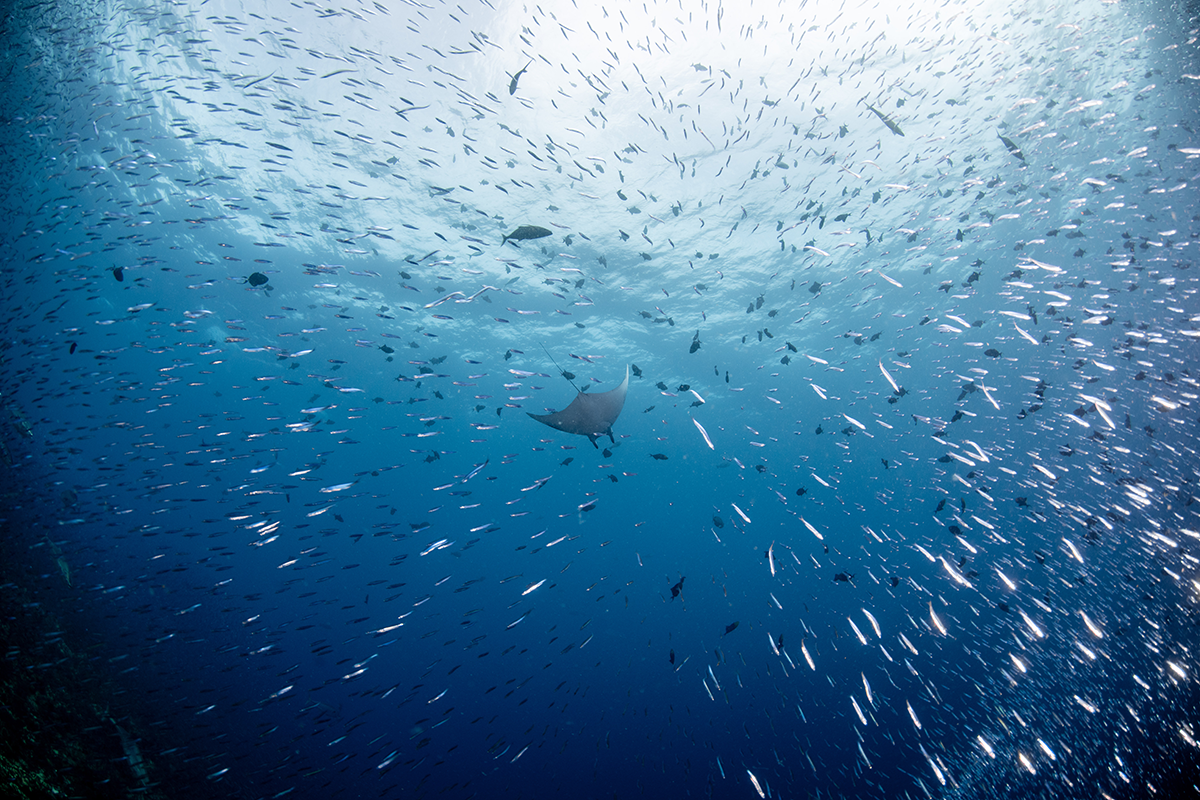
Manta Ray, Raja Ampat, Indonesia © Dani Escayola / Ocean Image Bank
Synergies between the BBNJ Agreement and CMS
ABNJ are home to important routes and habitats for many migratory species. Over 50 species listed on CMS appendices utilize ABNJ. The humpback whale (Megaptera novaeangliae), the leatherback turtle (Dermochelys coriacea), the blue shark (Prionace glauca), the European eel (Anguilla anguilla), and the waved albatross (Phoebastria irrorata) are amongst the many CMS-listed species that migrate through ABNJ. Management of these areas is therefore critical to safeguard marine life in these waters. Strengthening collaboration between CMS and the BBNJ Agreement is crucial for the protection of many migratory species.
CMS applies in areas beyond national jurisdiction. As defined by the Convention text, "Range State" includes “a State, flag vessels of which are engaged outside national jurisdictional limits, in taking that migratory species”. Thus, it is prohibited for CMS Parties to take Appendix I species in such areas.
CMS takes a global focus to the conservation of migratory species by providing frameworks for cooperation across national boundaries, while the BBNJ Agreement addresses governance gaps in ABNJ. As migratory species link coastal, EEZ and high seas ecosystems, collaboration between both agreements would allow for migratory species to be protected throughout their entire migratory ranges and life cycles. Together, they help secure ecological connectivity.
CMS identifies migratory species in need of protection and develops targeted conservation action plans, while the BBNJ Agreement provides mechanisms to strengthen marine governance in ABNJ. Through tools such as the establishment of MPAs, environmental impact assessments, and capacity-building initiatives, the Agreement helps fill existing management gaps in marine conservation.
Together, these measures support the protection of marine species and their habitats by enhancing area-based management and global coordination efforts. These measures align with Goal 2 of the CMS Samarkand Strategic Plan for Migratory Species 2024-2032 “the habitats and ranges of migratory species are maintained and restored, supporting their connectivity” and Target 3 of the Kunming-Montreal Global Biodiversity Framework “Conserve 30% of Land, Waters, and Seas”.
Furthermore, knowledge-sharing between both Agreements is necessary to help strengthen implementation. Enhanced cooperation could avoid duplication of work, ensure efficient use of resources, and improve compliance and accountability. Ultimately, meaningful protection of ABNJ can only be achieved through strong international cooperation.
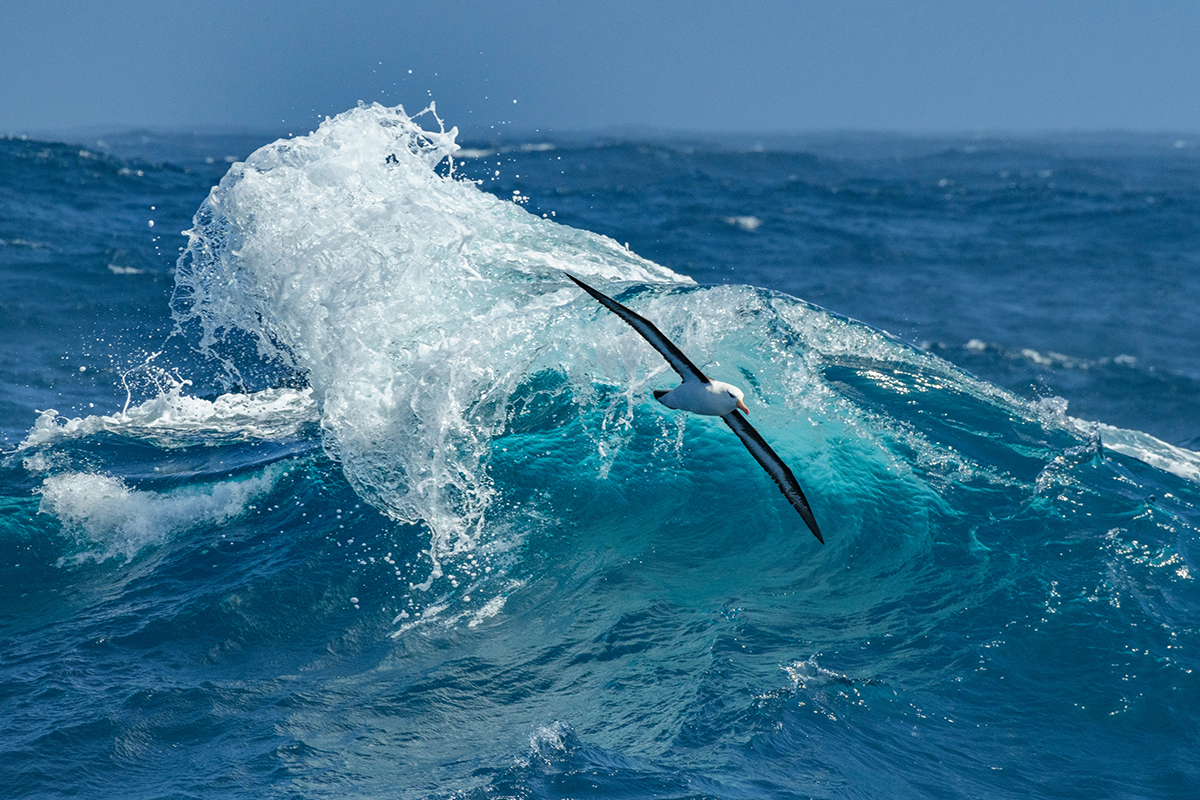
Black-browed Albatross soaring in the Drake Passage, Antarctica © Adobe Stock Images
Key Priorities for Collaboration with the BBNJ Agreement
Collaboration between CMS and the BBNJ Agreement could focus on two critical areas:
- Implementation of area-based management tools, including MPAs: Ensuring these areas are well located and form part of a network of habitats to maintain ecological connectivity between populations and life stages.
- Identifying key threats from human activities in ABNJ and solutions to mitigate such pressures: Assessing and addressing impacts from fisheries, deep-sea mining, habitat destruction, underwater noise, and ship traffic, all of which can significantly affect migratory species in marine environments.
Work under CMS is most directly aligned with the BBNJ Agreement’s provisions on area-based conservation measures, including MPAs, and on environmental impact assessment; whereas capacity building and technology transfer are embedded across the CMS Family with its many specialized instruments.
- Area-based conservation measures, including MPAs
CMS has adopted several Resolutions related to area-based conservation measures:
Resolution 12.13 on Important Marine Mammal Areas (IMMAs)
Resolution 12.17 on Conservation and Management of Whales and their Habitats in the South Atlantic Region
Resolution 12.24 on Promoting Marine Protected Area Networks in the ASEAN Region
Resolution 14.5 on Reducing the Risks of Vessel Strikes for Marine Megafauna
Resolution 14.6 on Deep-seabed Mineral Exploitation Activities and Migratory Species
Resolution 14.7 on Important Shark and Ray Areas (ISRAs)
Resolution 14.9 on Conservation Priorities for Cetaceans
Resolution 14.16 on Ecological Connectivity
Resolution 15.3 on Priorities for Area-based Conservation of Marine Migratory Species
Resolution 15.4 on Important Marine Turtles Areas (IMTAs)
Resolution 15.5 on Conserving Seamount Ecosystems
Resolution 15.9 on Seabirds and Marine Flyways
CMS work on Important Marine Mammal Areas (IMMAs), Important Shark and Ray Areas (ISRAs), and Important Marine Turtle Areas (IMTAs) can inform action on ABMTs under the BBNJ Agreement.

Leatherback Turtle, Western Australia © Emilie Ledwidge / Ocean Image Bank
- Environmental Impact Assessment
Additionally, CMS work on impact assessment can complement future work on EIAs under the BBNJ Agreement. CMS has adopted Resolution 7.2 (Rev.COP15) on Impact Assessment and Migratory Species, which covers EIA, as well as strategic environmental assessments and cumulative impact assessments.
There are also Resolutions that include EIA in relation to a specific topic, such as Resolution 11.27 (Rev.COP15) on Renewable Energy and Migratory Species and Resolution 12.14 on Adverse Impacts of Anthropogenic Noise on Cetaceans and Other Migratory Species, specifically its Annex: CMS Family Guidelines on Environmental Impact Assessments for Marine Noise-generating Activities. CMS is also a member of the Joint Noise Working Group.

Atlantic Spotted Dolphins, Bahamas © Ron Watkins / Ocean Image Bank
- Capacity-building and transfer of marine technology
CMS Samarkand Strategic Plan for migratory species 2024–2032, adopted through Resolution 14.1 (Rev.COP15), outlines the strategic goals and targets for the period 2024-2032. Goal 4 states that “Implementation of CMS is supported by adequate knowledge, capacity and resources”. Target 4.1 emphasizes the importance of access to relevant information and evidence-based guidance. Target 4.2 describes how to ascertain Parties have the technical capacity to effectively implement the Convention. Lastly, Target 4.3 highlights that sufficient resources need to be mobilized and secured to implement activities.
Additionally, CMS Concerted Actions, Species Specific Action Plans, and Conservation Management Plans always consider tailored capacity-building activities for the species or area in question.

Whale Shark © Adobe Stock Images