
Fact Sheet on Wildebeest Migration
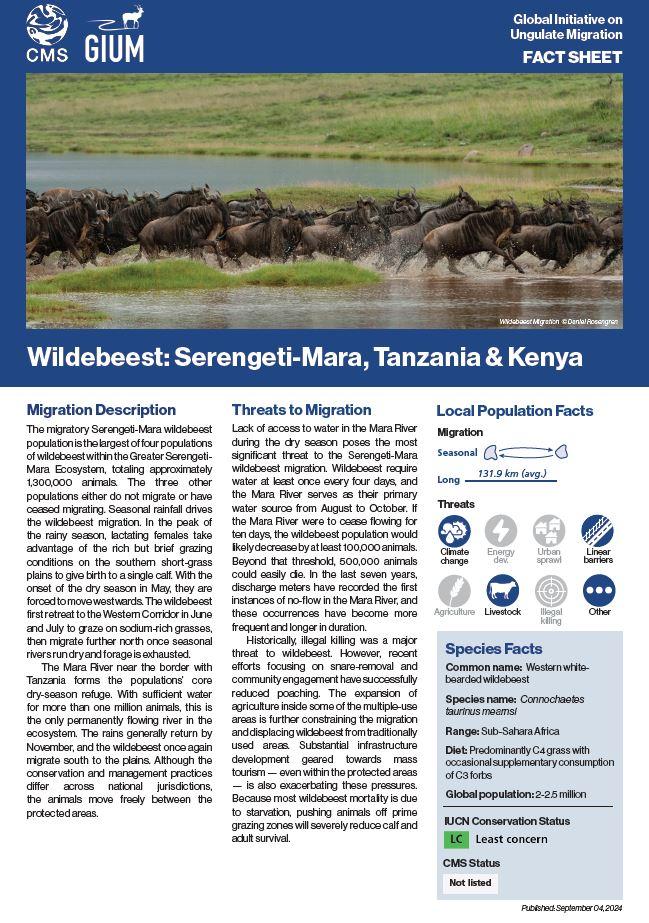
Fact Sheet on Wildebeest Migration - Serengeti-Mara, Tanzania & Kenya
The migratory Serengeti-Mara wildebeest population is the largest of four populations of wildebeest within the Greater Serengeti-Mara Ecosystem, totaling approximately 1,300,000 animals. The three other populations either do not migrate or have ceased migrating. Seasonal rainfall drives the wildebeest migration. In the peak of the rainy season, lactating females take advantage of the rich but brief grazing conditions on the southern short-grass plains to give birth to a single calf. With the onset of the dry season in May, they are forced to move westwards. The wildebeest first retreat to the Western Corridor in June and July to graze on sodium-rich grasses, then migrate further north once seasonal rivers run dry and forage is exhausted. The Mara River near the border with Tanzania forms the populations’ core dry-season refuge. With sufficient water for more than one million animals, this is the only permanently flowing river in the ecosystem. The rains generally return by November, and the wildebeest once again migrate south to the plains. Although the conservation and management practices differ across national jurisdictions, the animals move freely between the protected areas.
Fact Sheet on Wildebeest Migration: Mara-Loita, Kenya
The Mara-Loita wildebeest migration was one of the last remaining large terrestrial mammal migrations in Kenya but has sharply declined since 2010. The population consisted of 120,000-150,000 individuals in the 1970s. Around 26,700 animals remained as of 2024 (a 69-75% population decline), according to population estimates by the Kenyan government. Settlement and fence barriers in the Loita Plains and northern Mara Plains have severely restricted the migrating wildebeest (Figure 1). These barriers have compressed the surviving population into a patchwork of conservancies to the north and east of the Masai Mara National Reserve. Some animals still attempt to migrate, although many animals are now resident. The annual migration of Mara-Loita wildebeest is primarily driven by seasonal rainfall patterns and a soil fertility gradient. Between May and December, the population historically shared its dry season refuge along the Mara River with the Serengeti-Mara wildebeest. The Loita population migrated northeast during the wet season to reach the fertile, short-grass Loita Plains. Females took advantage of the rich volcanic grasslands across the Loita Plains during lactation. This population has also shown commuting behavior, moving back and forth from their seasonal ranges (east to west) throughout the year. There is evidence that some wildebeest may migrate south from the Loita area towards the Loliondo Plains, but more research is needed to determine if this is still a viable migration tactic present in the population.
| Adjunto | Tamaño |
|---|---|
| Fact Sheet on Wildebeest Migration - Serengeti-Mara, Tanzania & Kenya | 2.29 MB |
| Fact Sheet on Wildebeest Migration - MaraLoita, Kenya | 4.19 MB |