
Fact Sheet on Guanaco Migration
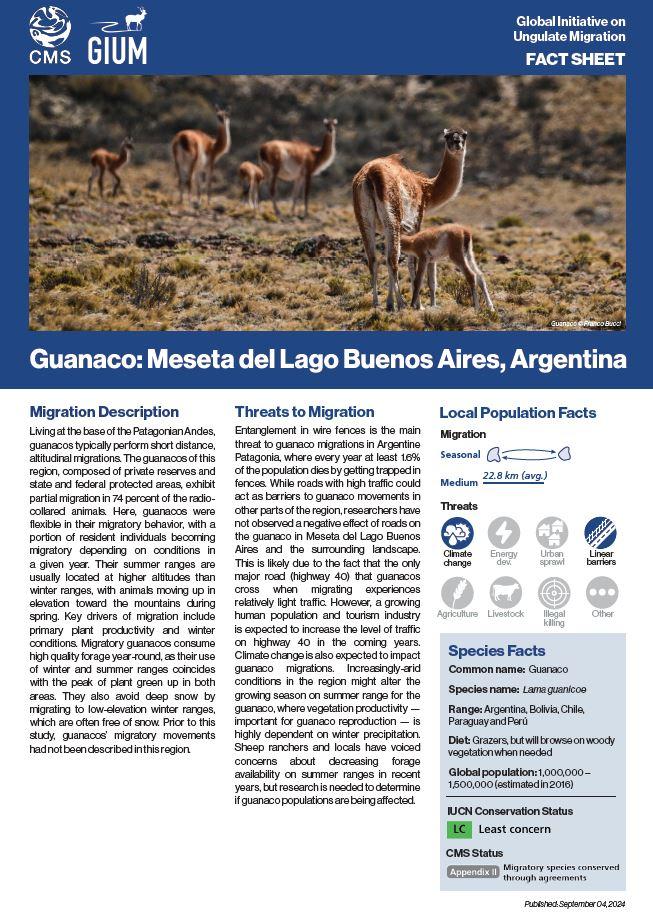
Living at the base of the Patagonian Andes, guanacos typically perform short distance, altitudinal migrations. The guanacos of this region, composed of private reserves and state and federal protected areas, exhibit partial migration in 74 percent of the radiocollared animals. Here, guanacos were flexible in their migratory behavior, with a portion of resident individuals becoming migratory depending on conditions in a given year. Their summer ranges are usually located at higher altitudes than winter ranges, with animals moving up in elevation toward the mountains during spring. Key drivers of migration include primary plant productivity and winter conditions. Migratory guanacos consume high quality forage year-round, as their use of winter and summer ranges coincides with the peak of plant green up in both areas. They also avoid deep snow by migrating to low-elevation winter ranges, which are often free of snow. Prior to this study, guanacos’ migratory movements had not been described in this region.
Across the Argentine Patagonia, migratory guanacos face a range of threats, including the proliferation of private property fences, illegal hunting, grassland degradation and forage competition from extensive livestock farming—all of which contribute to habitat fragmentation. In the Auca Mahuida Volcano region, the most significant threats are habitat degradation due to hydrocarbon development and illegal hunting facilitated by the network of roads created for hydrocarbon extraction activities. More research is needed to understand the level of human activity that may impact guanaco movements and the degree of habituation possible for populations living near new and ongoing development.
Guanacos in Argentina’s Monte León National Park and surrounding lands – predominantly coastal shrublands and grasslands – typically perform elevational migrations. They generally spend winters in the northern extent of their migratory range, near where the Santa Cruz River carves a broad, low-elevation valley that may provide shelter from snow and harsh winter conditions. As the austral spring approaches in September and October, guanacos migrate south to areas ~200m higher in elevation than their winter range, where they give birth and forage on vegetation in optimal nutritional stages. November is the start of the mating season, where males establish breeding territories that they defend through the summer.