
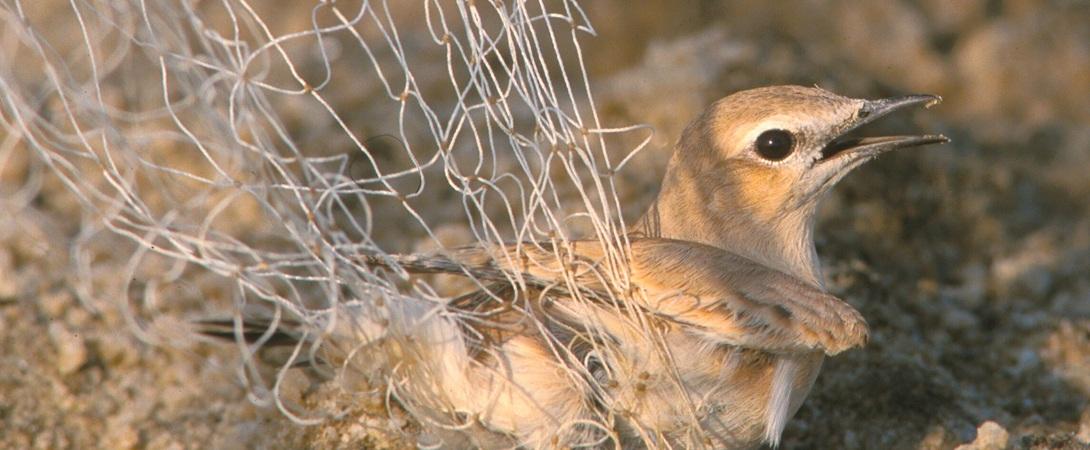
Illegal Taking of Migratory Birds
The Illegal Taking of Migratory Birds is Threatening Their Survival
The overexploitation of birds, i.e., removing and using more individuals from a population than what it can sustain, e.g., for food or as pets, is one of the most important threats to wild birds globally. According to the State of the World’s Birds (BirdLife International 2022), overexploitation is the most geographically widespread threat to birds, affecting up to 45% of species.
Illegal taking of birds is a subcategory of overexploitation and is defined as any action involving hunting, capturing, deliberate killing or trapping that is not allowed according to the national legislation of the country in question and/or under the commitments undertaken by that country through international conventions and multilateral environmental agreements (MEAs) it has signed up to.
Inevitably, what constitutes illegal taking depends on what is allowed by national or regional legislation or more often, what is not clearly defined as prohibited. A non-exhaustive list of examples of illegal taking of birds includes killing or trapping birds for food, trapping or stealing from nests for trading as pets, food or for other uses.
Taking is done with various methods, including with mist nets, lime sticks, shotguns, air guns, intentional poisoning, and traps that either kill the birds or catch them alive. Illegal taking of birds is difficult to detect, and because of its illegal character, very difficult to monitor accurately. Governments, NGOs and researchers have tried to assess the scale of illegal killing and taking in some parts of the world, but the global scale of the problem is still largely unknown and probably underestimated.
CMS Initiatives on the Prevention of Illegal Taking of Migratory Birds
Tackling illegal killing, taking and trade of migratory birds is usually a complex issue, dependent on national and local circumstances. Unclear and insufficient legislation, insufficient resources for law enforcement, traditions and cultural beliefs, poverty, profit making and lack of awareness of the significance and massive impact of wildlife crime at the enforcement or judicial level are common examples of why it is continuing to happen.
Best practices on dealing with illegal taking of birds involve a multitude of measures and multi stakeholder groups. The Convention on Migratory Species adopted in 2014 Resolution 11.16 (Rev. COP14) on The Prevention of Illegal Killing, Taking and Trade of Migratory Birds.
Based on the mandate of this Resolution, the CMS Secretariat convened the Intergovernmental Task Force on Illegal Killing, Taking and Trade of Migratory Birds in the Mediterranean (MIKT) in 2016 and the Asia Pacific Illegal Taking of Migratory Birds Intergovernmental Task Force (ITTEA) in 2022. A Task Force for Illegal Taking of Migratory Birds in South-West Asia convened in 2025 and a West African Vulture Conservation Action Plan 2023-2043 was presented at COP14 in 2024. Other regions of interest for assessing the impact of illegal taking include Sub-Saharan Africa and the Caribbean.

The Task Force has been established under CMS COP Resolution 11.16 on the illegal killing, taking and trade of migratory birds to facilitate international cooperation as well as the implementation of the existing guidelines and action plans in particular the Tunis Action Plan 2013-2020 for the Eradication of Illegal Killing, Trapping and Trade of Wild Birds. It will also consider whether any new guidelines, action plans or other recommendations to respond to specific problems are necessary. Moreover, it will enable the exchange of information, training and education, law enforcement, deterrence and prevention to reduce the mortality rate among migratory birds.
Access the MIKT Task Force Webpage

The Intergovernmental Task Force to Address Illegal Hunting, Taking and Trade of Migratory Birds in the East Asian-Australasian Flyway (ITTEA) was established in line with the mandate provided by the Resolution 11.16 (Rev.COP12), entitled “The Prevention of Illegal Killing, Taking and Trade of Migratory Birds” to assist the Parties to the Convention on Migratory Species (CMS) and its associated instruments, relevant MEAs and Conventions to fulfil their obligations to protect migratory birds from illegal hunting, taking and trade.
Access the ITTEA Task Force webpage

The South-West Asia Illegal Taking of Migratory Birds Intergovernmental Task Force (SWA ITB TF) is established under CMS Resolution 11.16 (Rev. COP14) and related Decisions 14.126 to 14.129 and supports the Parties to the CMS, its related instruments, and other relevant MEAs in meeting their obligations to safeguard migratory birds from illegal hunting, taking, and trade in the South-West Asia Region. .
Access the SWA ITB Task Force webpage