

A Brief History of ASCOBANS
CONCEPTION
Widespread concern over the decline of harbour porpoise populations around Europe acted as a catalyst for the development of ASCOBANS. The idea for an instrument for small cetaceans of the Baltic and North Seas started at the First Meeting of the Conference of the Parties to CMS in 1985. At COP1, a Working Group was established to draft a suitable agreement.
However, no consensus was reached regarding the content and scope, and the Working Group was disbanded in 1988. The process was revived in 1990, when a Memorandum of Understanding on Small Cetaceans of the North Sea was adopted by the Third North Sea Ministerial Conference.
NEGOTIATION
The negotiations to agree the treaty culminated at the CMS COP3, held in Geneva, Switzerland in 1991. The Agreement on the Conservation of Small Cetaceans of the Baltic and North Seas was concluded on 17 March 1992 and opened for signature in the UN Headquarters in New York, USA.
The Secretary General of the United Nations has assumed the functions of Depository of the Agreement.
ENTRY INTO FORCE
The Agreement entered into force on 24 November 1994, having secured the requisite number of ratifications (six): Belgium, Denmark, Germany, the Netherlands, Sweden, and the United Kingdom. The Secretariat is now housed in the UN Campus on the banks of the River Rhine, in the building which used to provide office space for German parliamentarians.
In 2008, the extension of the Agreement Area further to west and southwest entered into force. That changed the name to Agreement on the Conservation of Small Cetaceans of the Baltic, North East Atlantic, Irish and North Seas, as it is known today.
ASCOBANS is open for accession by all Range States (i.e. any state that exercises jurisdiction over any part of the range of a species covered by the Agreement or whose flag vessels engage in operations adversely affecting small cetaceans in the Agreement area) and by regional economic integration organisations.
THE WORK
Since migrating cetaceans regularly cross national boundaries, their protection can only effectively be achieved by means of international cooperation. Therefore the aim of ASCOBANS is to promote close cooperation amongst Parties with a view to achieving and maintaining a favourable conservation status for small cetaceans in the Agreement Area. A Conservation and Management Plan, which forms part of the Agreement, obliges Parties to engage in habitat conservation and management, surveys and research, pollution mitigation and public information. To achieve its aim, ASCOBANS also cooperates with Range States that have not (yet) acceded to the Agreement, with relevant intergovernmental organizations, and non-governmental organizations.
Three main bodies promote the implementation of the Agreement:
The Meeting of the Parties (MOP) is the decision-making body of the Agreement. It meets every three years to assess progress and develop further steps in the implementation of ASCOBANS. Non-Party Range States and relevant regional, intergovernmental and non-governmental organizations can attain observer status to attend MOP meetings without having power to vote.
The Advisory Committee (AC), which now meets once a year (except on MOP years), provides scientific and policy advice to the Parties and the Secretariat on the conservation and management of small cetaceans and on other matters related to the running of the Agreement. Each Party is entitled to appoint one member to the AC, who may be accompanied by advisors. As with the MOP, external observers may take part in AC meetings, while the nominated members are the only ones entitled to vote.
The ASCOBANS Secretariat acts as the coordinating body of the Agreement. It provides administrative support, gathers, and disseminates relevant information and supports the Parties in the implementation of the Agreement, including facilitating the work of different working groups. In addition, it prepares content for, organizes and services the meetings of the MOP and the AC. As with CMS and some of its other regional daughter agreements, the ASCOBANS Secretariat is administered by the United Nations Environment Programme, and is based in Bonn, Germany.
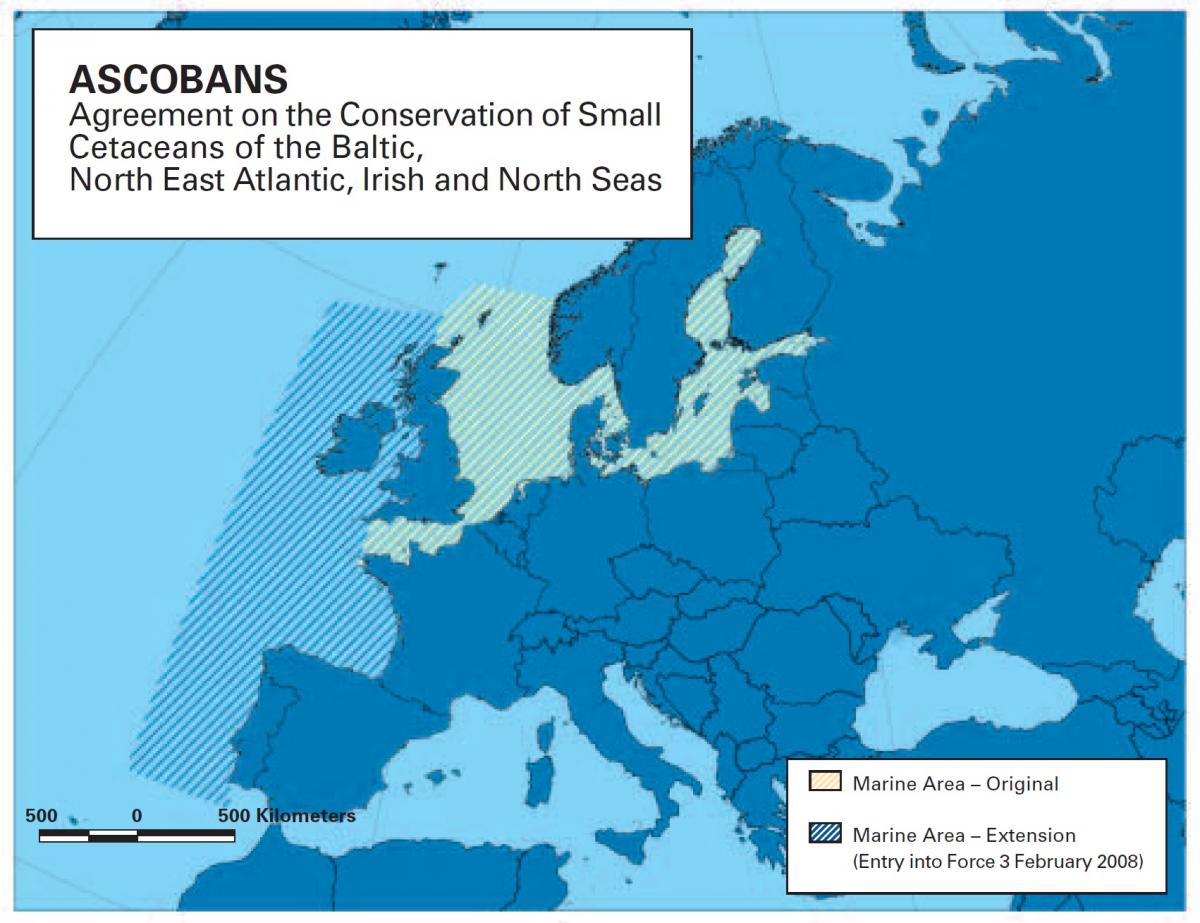
The Agreement Area is defined as follows:
"... the marine environment of the Baltic and North Seas and contiguous area of the North East Atlantic, as delimited by the shores of the Gulfs of Bothnia and Finland; to the south-east by latitude 36°N, where this line of latitude meets the line joining the lighthouses of Cape St. Vincent (Portugal) and Casablanca (Morocco); to the south-west by latitude 36°N and longitude 15°W; to the north-west by longitude 15° and a line drawn through the following points: latitude 59°N/longitude 15°W, latitude 60°N/longitude 05°W, latitude, 61°N/longitude 4W;latitude 62N/ longitude 3W; to the north by latitude 62°N; and including the Kattegat and the Sound and Belt passages."
Ratification Status
| Country | Status | Country ratification date | Notes |
|---|---|---|---|
| Belgium | Party | Final Act: 13.09.1991; Signature: 06.11.1992 |
|
| Denmark | Party | Approved. Final Act: 13.09.1991; Signature: 19.08.1992 |
|
| Estonia | Range State | ||
| Finland | Party | Acceded. Final Act: 13.09.1991 |
|
| France | Party | Acceded |
|
| Germany | Party | Final Act: 13.09.1991; Signature: 09.04.1992 |
|
| Ireland | Range State | ||
| Latvia | Range State | ||
| Lithuania | Party | Acceded |
|
| Netherlands (Kingdom of the) | Party | Approved. Final Act: 13.09.1991; Signature: 29.07.1992 |
|
| Norway | Range State | ||
| Poland | Party | Acceded |
|
| Portugal | Range State | ||
| Russian Federation | Range State | ||
| Spain | Range State | ||
| Sweden | Party | Deposited. Final Act: 13.09.1991; Signature: 31.03.1992 |
|
| European Union | Signed but not ratified | Final Act: 13.09.1991; Signature: 07.10.1992+ |
|
| United Kingdom of Great Britain & Northern Ireland | Party | Final Act: 13.09.1991; Signature: 16.04.1992. (Including Guernsey) |
|
| Belgium | Party | ||
| Denmark | Party |
Related content
| Scientific name | Common name | Class | Order | Family | Appendix (App. I / App. II) |
|---|---|---|---|---|---|
| Delphinus delphis | Short-Beaked Common Dolphin | Mammalia | Cetacea | Delphinidae | / |
| Globicephala melas | Long-Finned Pilot Whale | Mammalia | Cetacea | Delphinidae | / |
| Grampus griseus | Risso's Dolphin | Mammalia | Cetacea | Delphinidae | / |
| Hyperoodon ampullatus | Northern Bottlenose Whale | Mammalia | Cetacea | Ziphiidae | / |
| Lagenorhynchus acutus | Atlantic White-Sided Dolphin | Mammalia | Cetacea | Delphinidae | / |
| Lagenorhynchus albirostris | White-Beaked Dolphin | Mammalia | Cetacea | Delphinidae | / |
| Orcinus orca | Killer Whale | Mammalia | Cetacea | Delphinidae | / |
| Phocoena phocoena | Harbour Porpoise | Mammalia | Cetacea | Phocoenidae | / |
| Stenella coeruleoalba | Striped Dolphin | Mammalia | Cetacea | Delphinidae | / |
| Tursiops truncatus | Bottlenose Dolphin | Mammalia | Cetacea | Delphinidae | / |
| Ziphius cavirostris | Cuvier's Beaked Whale | Mammalia | Cetacea | Ziphiidae | / |