
Fact Sheets on Giraffes
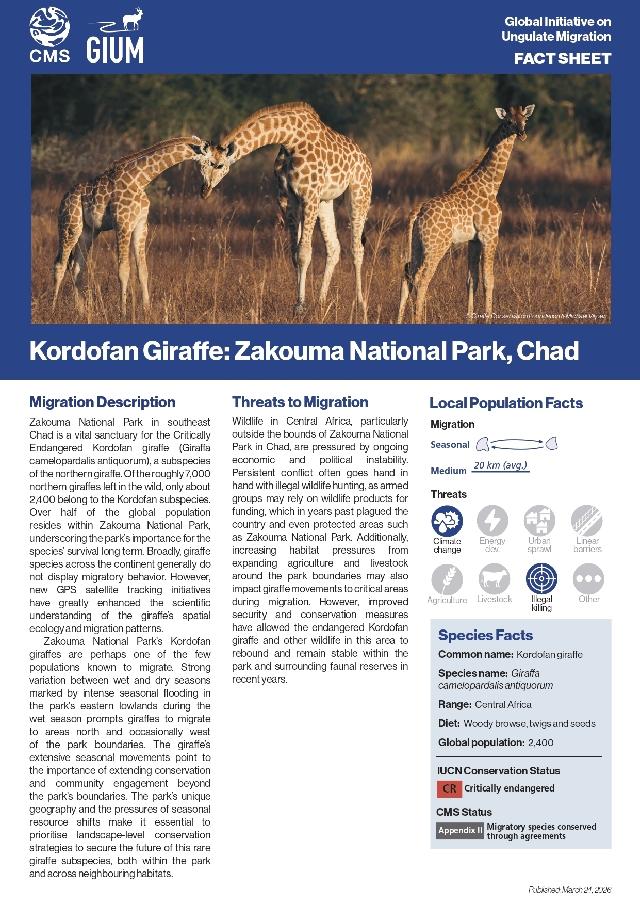
Kordofan Giraffe: Zakouma National Park, Chad
Zakouma National Park in southeast Chad is a vital sanctuary for the Critically Endangered Kordofan giraffe (Giraffa camelopardalis antiquorum), a subspecies of the northern giraffe. Of the roughly 7,000 northern giraffes left in the wild, only about 2,400 belong to the Kordofan subspecies. Over half of the global population resides within Zakouma National Park, underscoring the park’s importance for the species’ survival long term. Broadly, giraffe species across the continent generally do not display migratory behavior. However, new GPS satellite tracking initiatives have greatly enhanced the scientific understanding of the giraffe’s spatial ecology and migration patterns.
Nubian Giraffe: Murchison Falls National Park, Uganda
Murchison Falls National Park is home to the world’s largest remaining population of Nubian giraffes, serving as the primary stronghold for this Critically Endangered subspecies of giraffe. The population in the park has grown steadily in recent years, with 2,000 individuals reported in 2025, according to the Giraffe Conservation Foundation’s State of Giraffe 2025. The giraffe population in Murchison Falls exhibits partial migration, with many individuals migrating from the Acacia (Vachellia/Senegalia) dominated savannas during the wet season to broad-leaf evergreen savannas in the dry season, reflecting both large-scale migrations and finer-scale foraging adjustments. As the dry season begins, giraffes migrate east to habitats characterized by broadleaf tree species. Between mid and late April, they return west as the short rainy season starts. During the wet seasons, giraffes concentrate in the park’s western sector. Migration patterns also vary by sex.
| Attachment | Size |
|---|---|
| Giraffe_MurchisonFallsNP_UGA.pdf | 1.86 MB |
| Giraffe_ZakoumaNP_TCD.pdf | 2.02 MB |