
Fact Sheet on European Bison Migration in Białowieża, Poland
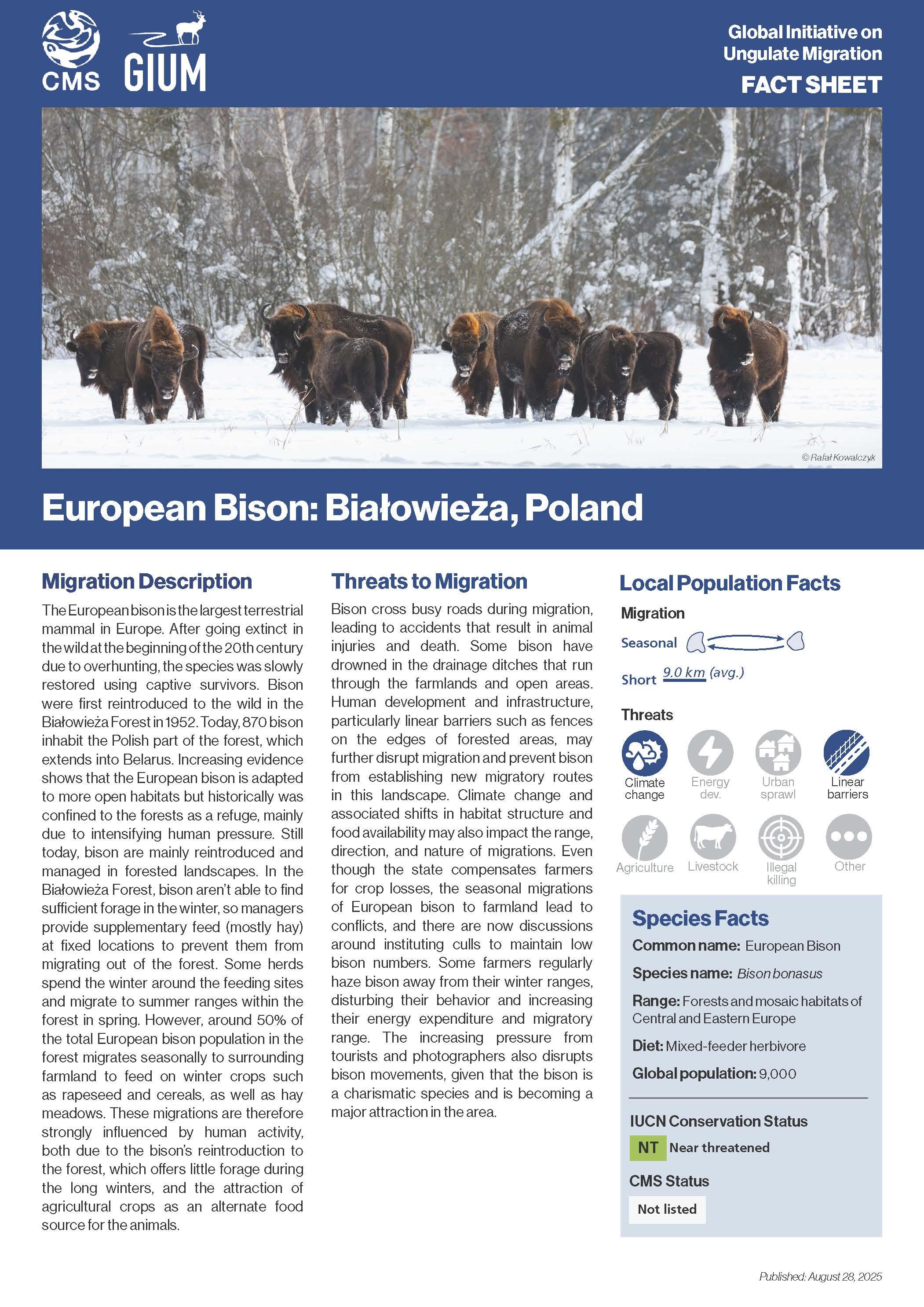
The European bison is the largest terrestrial mammal in Europe. After going extinct in the wild at the beginning of the 20th century due to overhunting, the species was slowly restored using captive survivors. Bison were first reintroduced to the wild in the Białowieża Forest in 1952. Today, 870 bison inhabit the Polish part of the forest, which extends into Belarus. Increasing evidence shows that the European bison is adapted to more open habitats but historically was confined to the forests as a refuge, mainly due to intensifying human pressure. Still today, bison are mainly reintroduced and managed in forested landscapes. In the Białowieża Forest, bison aren’t able to find sufficient forage in the winter, so managers provide supplementary feed (mostly hay) at fixed locations to prevent them from migrating out of the forest. Some herds spend the winter around the feeding sites and migrate to summer ranges within the forest in spring. However, around 50% of the total European bison population in the forest migrates seasonally to surrounding farmland to feed on winter crops such as rapeseed and cereals, as well as hay meadows. These migrations are therefore strongly influenced by human activity, both due to the bison’s reintroduction to the forest, which offers little forage during the long winters, and the attraction of agricultural crops as an alternate food source for the animals.
| Attachment | Size |
|---|---|
| Fact Sheet on European Bison Migration in Białowieża, Poland | 1.46 MB |