

Momentum Builds for Stronger National Laws on Migratory Species Conservation Following First Global Workshop
Bonn, 1 September 2025 - National legislation is the primary means through which commitments made under the Convention on the Conservation of Migratory Species of Wild Animals (CMS) become legally binding and enforceable at the national level. It serves to incorporate the provisions and obligations of CMS into domestic law, providing a legal basis for the conservation of migratory species and their habitats, as well as the regulation of activities that impact migratory species.
The first Global Workshop on CMS Legislation, held from 3 to 5 June 2025 at the UN Campus in Bonn, marked a milestone in global efforts to support countries in strengthening national legal frameworks for the conservation of migratory species. Organized under the CMS National Legislation Programme (NLP), the three-day workshop brought together government representatives, legal experts and international stakeholders from UN bodies, other multilateral environmental agreements, NGOs and academia.
“Effective implementation of the Convention relies on the adoption and implementation of effective national legislation, and this workshop provided an important opportunity for information-sharing, dialogue and collaboration.”
Amy Fraenkel, Executive Secretary of CMS

Established in 2017 at the 12th Meeting of the Conference of the Parties (CMS COP12 Resolution 12.9), the National Legislation Programme offers a facilitative, non-adversarial and Party-driven process to help Parties align their national legislation with the Convention’s objectives and ensure long-term compliance.
The workshop took place against a backdrop of escalating threats to migratory species. According to the State of the World’s Migratory Species (2024), overexploitation is one of the most widespread and urgent threats confronting species listed under CMS.
The report found that 89% of species listed on CMS Appendix I — endangered migratory species requiring strict protection and habitat conservation – and 68% of those listed on Appendix II — species needing international cooperation for conservation and management – are impacted by overexploitation. Alongside overexploitation, migratory species face pressures from habitat loss, degradation and fragmentation, pollution, invasive species, and climate change. With 76% of CMS Appendix I species already in decline, urgent legal and policy responses are needed to reverse these trends.
In this context, the workshop provided a timely and practical forum to support long-term compliance with key CMS provisions, particularly Articles III.4(a), III.4(b), and III.5, which set forth the Convention’s obligations related to habitat conservation, obstacles to migration and the prohibition of “take” of CMS Appendix I-listed species.
Workshop participants examined the core aspects of national legislation that are essential to effectively implement the Convention, discussed and compared experiences, identified legislative gaps or complexities, and formulated best practices for the implementation of the Convention.
Key topics addressed included:
Implementing the Take Prohibition (Article III.5):
- A central focus of the workshop was ensuring effective national implementation of the Article III.5 obligation to prohibit the taking of Appendix I-listed species.
- The workshop covered legal obligations in respect of Article III.5 take prohibition of Appendix I species and gave an overview of the definition of “taking”, listing of species, geographical scope of application and exceptions to the prohibition.
- The newly released Legislative Guidance Document: Exceptions to the Prohibition on Taking of Appendix I-listed Species under CMS Article III.5 was presented to the public for the first time.
- With regards to exceptions, participants focused on the need for clear science-based justifications, a narrow interpretation of the various exceptions, and the importance of inter-ministerial coordination.
Addressing ecological connectivity through Articles III.4(a) and (b):
- The draft Legislative Guidance for Maintaining, Improving and Restoring Ecological Connectivity was presented for input and comments, after which it will be finalized.
- The guidance offers recommendations that could be considered in connectivity-related laws, such as land-use planning, protected area networks, environmental impact assessments, and regional cooperation to maintain migration corridors and habitat connectivity.
Addressing known and emerging legal threats:
- Sessions also covered the risk posed to CMS Appendix I species by international trade, unsustainable use of Appendix II species, and the threat of lead poisoning from ammunition and fishing gear.
- The need to look into efficiency and deterrence impact of laws implementing Article III.5 was also discussed.
Strengthening collaboration through partnerships:
The workshop highlighted synergies with other initiatives facilitating national legislative review, including:
- UNEP’s Montevideo Environmental Law Programme,
- The CITES National Legislation Project, and
- The FAO-led Sustainable Wildlife Management Programme.
A summary of the workshop discussions is available on the workshop’s webpage.
Contact:
For more information, contact the CMS Secretariat at [email protected] or Ms. María José Ortiz, Legal Officer, at [email protected].
Further details on the CMS National Legislation Programme are available at https://www.cms.int/en/activities/national-legislation-programme.
Acknowledgement:
The CMS Secretariat would like to thank the European Union for its generous support and commitment to the CMS National Legislation Programme over the past six years, whose financial support also made this workshop possible. Thanks also go to the United Kingdom for funding the participation of additional delegates.
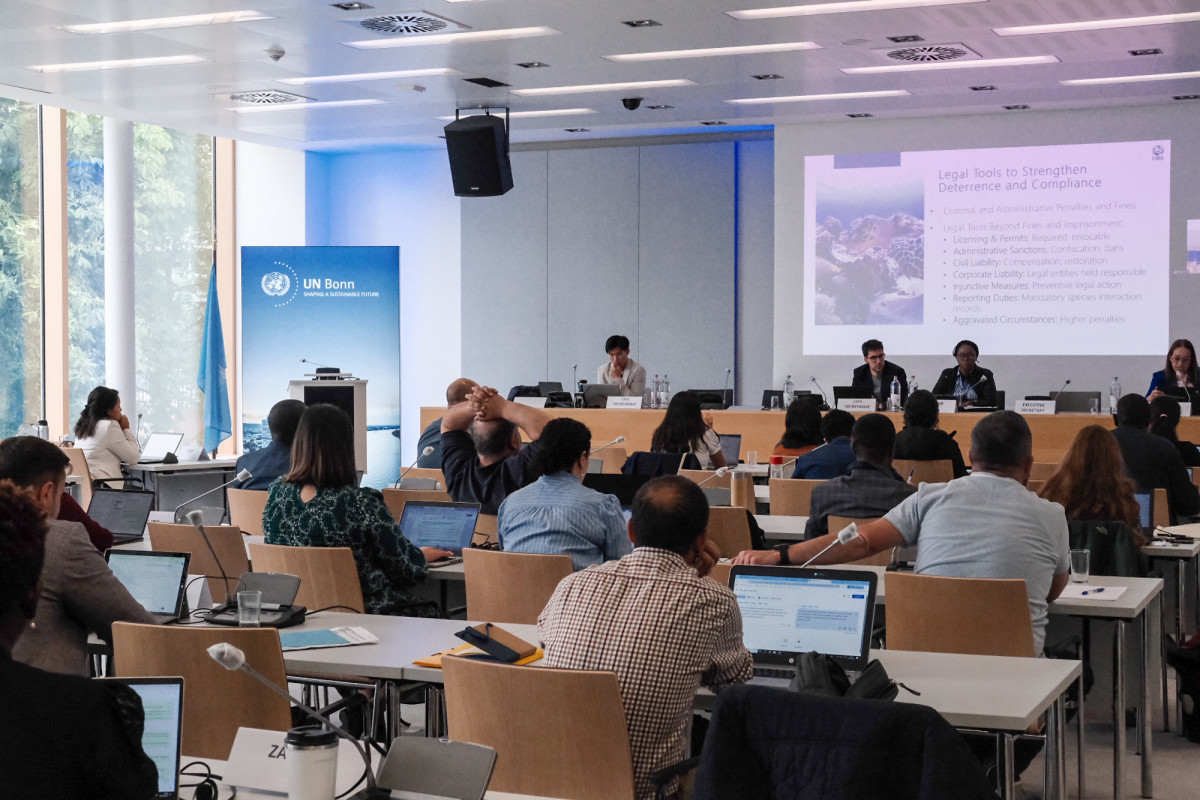
More photos of the workshop can be found in the Flickr Photo Gallery

The European Union was recognized as Champion Plus for their generous support and commitment towards strengthening national legislation for migratory species for the period 2020-2025. This activity has been funded with the contribution granted by the European Commission under the Migratory Species Champion Programme and through the Global Public Goods and Challenges (GPGC Programme) Cooperation Agreements with UNEP.