
Global Initiative on Ungulate Migration
What is GIUM?
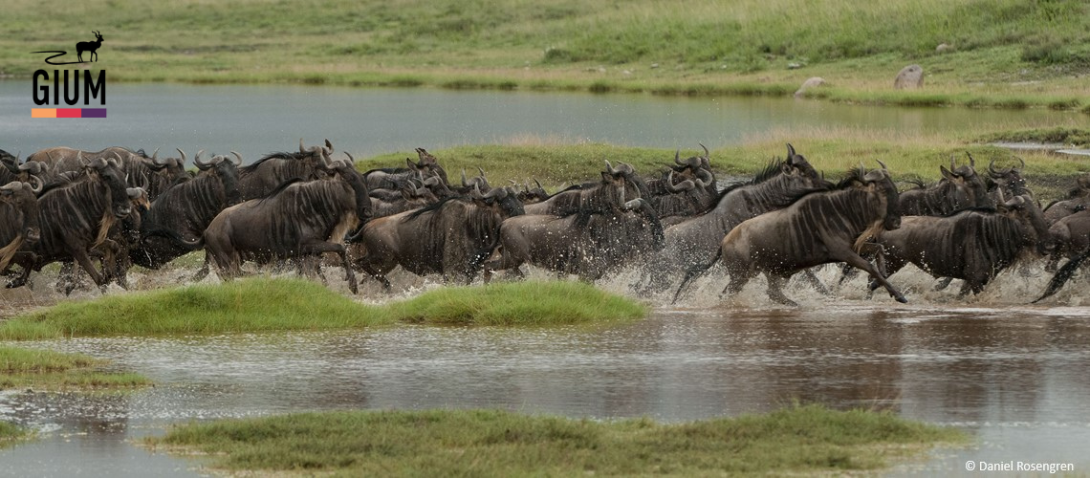
Most of the world’s large terrestrial mammals are ungulates, and many of them migrate seasonally to sustain their massive herds on landscapes around the planet. The abundance that migration supports in turn promotes the resilience of the ecosystems that sustain subsistence hunting, rural economies, and provides the primary prey base for most of the world's top carnivores.
Today, the slow and steady spread of our human footprint represents a common threat to ungulate migrations across the globe. The wild landscapes that migrations require are increasingly fragmented and degraded by roads, fences, agriculture, energy development, and human settlements. Migrations are being lost for species as diverse as bighorn sheep, elk, bison, pronghorn, springbok, Thompson’s gazelle, hartebeest, scimitar-horned oryx, zebra, and wildebeest.
The Global Initiative on Ungulate Migration was formed to address threats common to migratory ungulates worldwide. In 2024, the GIUM launched the Atlas of Ungulate Migration, the world’s first living compendium of ungulate migration maps. The Atlas is intended to serve as a global tool to support migration conservation worldwide with publicly available migration maps that can inform conservation planning and infrastructure development. Created from tracking data and expert knowledge, corridor maps are being used to target fences for modification or removal, site road-crossing structures, adjust energy development footprints, and focus conservation efforts on working lands.
The GIUM’s participants include global experts representing the world's major terrestrial regions and most, if not all, of its longest migrations (e.g., Serengeti wildebeest, Arctic caribou, Mongolian gazelle, white-eared kob, African elephants, among many others). As a community of practice, GIUM seeks to spark conservation efforts worldwide by sharing and discussing new, ongoing, and proven approaches to maintain migration corridors across large landscapes.
Join Us!
Participation in the Global Initiative on Ungulate Migration is open to anyone who can contribute information, GPS data, or expert knowledge to help delineate current or historical ungulate migrations.
Follow GIUM
To see updates and read more about the migrations we map, follow @migratinghooves on:


For longer form stories see Medium
Atlas of Ungulate Migration
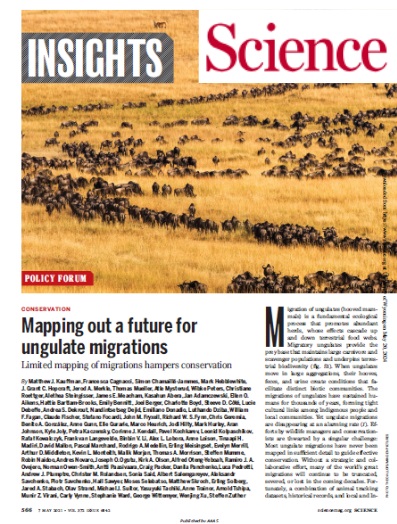
Driven by tracking data on ungulate migrations, the Atlas of Ungulate Migration serves as a repository for up-to-date migration maps that can inform conservation planning, infrastructure development and policy making. The maps detail high, medium and low-use migration corridors for a diversity of species, ranging from the iconic Serengeti wildebeest and African elephant, to the saiga of the Central Asian steppe. Most importantly, the maps illustrate where critical migration routes intersect with linear barriers like roads or railways. This atlas represents the best available science for extant migrations, with downloadable maps each accompanied by a factsheet describing the migration in detail, the data analysis, and its specific threats. The atlas is living, and continually updated.
Research Methods
Over the last two decades, advances in GPS technology have enabled a renaissance in the study of ungulate migration. A variety of humane capture methods allow researchers to attach GPS collars and track animal movement hourly for years at a time. The movement data from such studies are allowing researchers to document - and discover, in some cases - migrations in unprecedented scope and detail.


GPS Points to Population Level Corridors
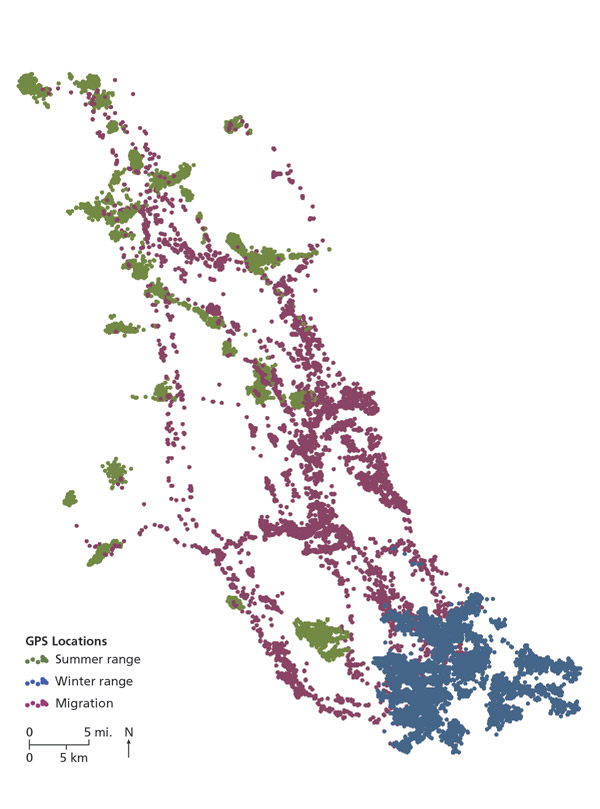
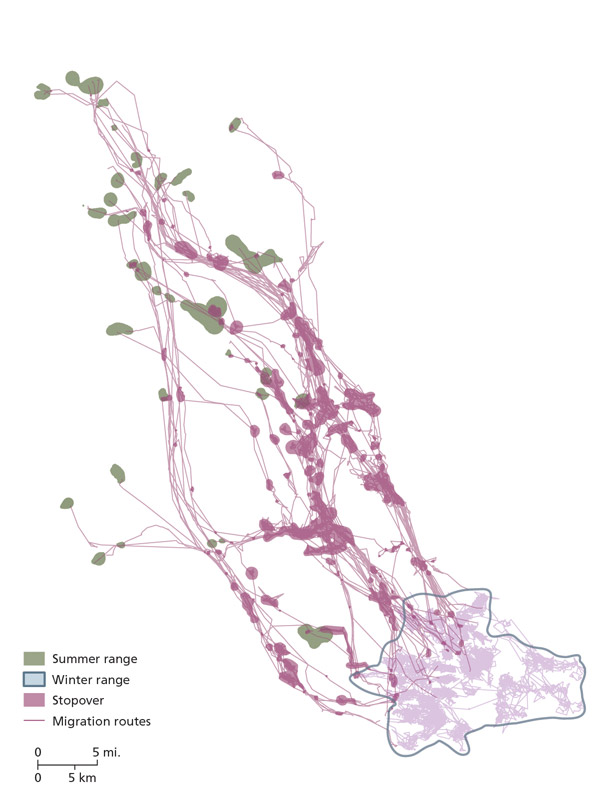
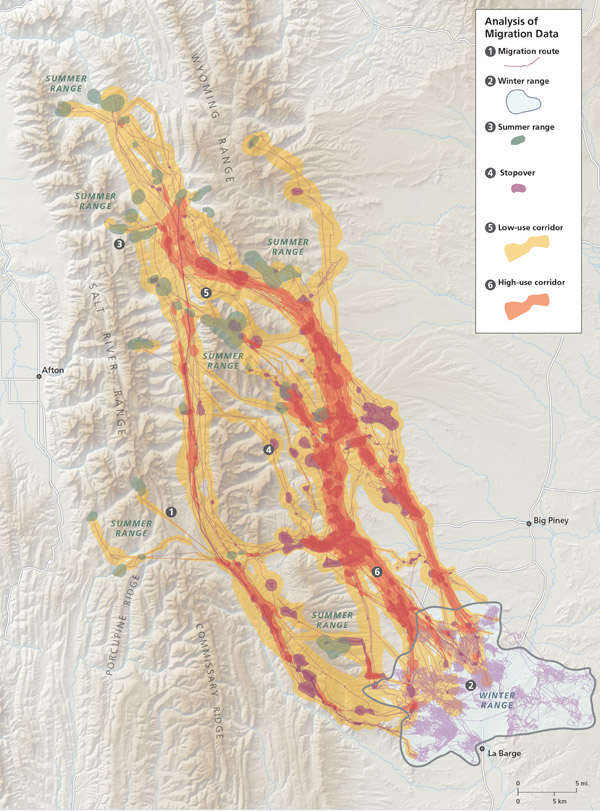
For many ungulate herds around the world, conserving their migrations is constrained by a lack of detailed maps that identify key corridors or linkage areas. New analytical techniques now allow researchers to build detailed migration maps from the seasonal paths of tracked individuals. To delineate migrations, researchers first categorize all animal locations by season. In temperate regions, the key seasons are summer and winter ranges, whereas in tropical regions, most migratory herds move between dry and rainy season habitat. Statistical analyses are then used to delineate polygons representing seasonal ranges, stopovers, and corridors. A final step is to calculate high- and low-use corridors, which allows conservationists to target and conserve the most important corridor segments or linkage areas. Not all migratory herds use distinct corridors, but even mapping of wide-ranging, nomadic species, can illustrate critical habitats needed to sustain seasonal movements.
Species being studied by the Global Initiative on Ungulate Migration
African elephant
Caribou
Gazelle
Guanaco
Khulan
Mule deer
Moose
White-eared Kob
Wildebeest
Zebra
Reindeer
Red deer
Alpine ibex
Saiga antelope
Eland
Takin
Tibetan antelope
Participants
Join Us!
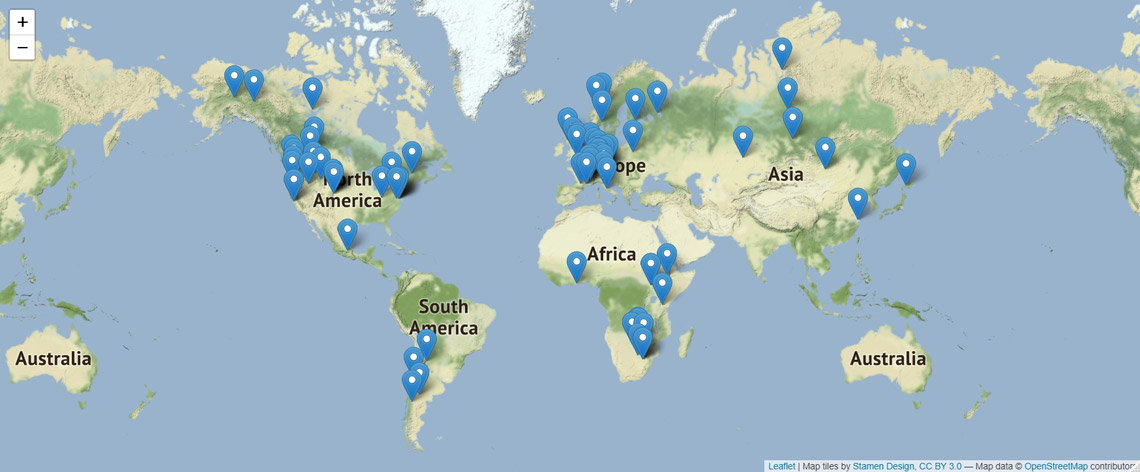
Participation in the Global Initiative on Ungulate Migration is open to anyone who can contribute information, GPS data, or expert knowledge to help delineate current or historical ungulate migrations. The GIUM also includes conservation practitioners, working on-the-ground in countries around the world, to help the initiative identify the types of actionable maps that are necessary to catalyze global efforts to conserve ungulate migration.
The Global Initiative on Ungulate Migration is comprised of researchers and conservationists around the globe who are conducting research on migratory ungulates or working to advance their conservation.
Science Advisory Board
| Name (first, last) | Institution | Website | Email Address |
|---|---|---|---|
| Francesa Cagnacci | Fondazione Edmund Mach | https://www.fmach.it/ | [email protected] |
| Grant Hopcraft | University of Glasgow | https://www.gla.ac.uk/researchinstitutes/bahcm/staff/granthopcraft/ | [email protected] |
| Matthew Kauffman | US Geological Survey | http://www.migrationinitiative.org | [email protected] |
| Simon Chamaillé-Jammes | Centre National de la Recherche Scientifique | https://simonchamaillejammes.mystrikingly.com/ | [email protected] |
| Thomas Mueller | Senckenberg Nature Research Society | https://www.senckenberg.de/en/institutes/sbik-f/movement-ecology-and-bi… | [email protected] |
| Wibke Peters | Bavarian State Institute of Forestry | [email protected] |
Participants
| Name (first, last) | Institution | Website | Email Address |
|---|---|---|---|
| Albert Salemgareyev | Association for the Conservation of Biodiversity of Kazakhstan | www.acbk.kz | [email protected] |
| Aleksandr Savchenko | Department of Wildlife Resource Studies and Reserve Management, Institute of Ecology and 159 Geography, Siberian Federal University, 660041, Krasnoyarsk, pr. Svobodnyi, Russia | [email protected] | |
| Alethea Steingisser | University of Oregon | infographics.uoregon.edu | [email protected] |
| Alex Lobora | Tanzania Wildlife Research Institute (TAWIRI) | [email protected] | |
| Andres J. Novaro | INIBIOMA-CONICET-Universidad del Comahue and Wildlife Conservation Society-Argentina | [email protected] | |
| Andy Plumptre | Key Biodiversity Areas Secretariat, c/o BirdLife International | www.keybiodiversityareas.org | [email protected] |
| Anne Gunn | Circum-Arctic Rangifer Monitoring and Assessment (CARMA) | https://carma.caff.is/ | [email protected] |
| Anne Loison | CNRS- Alpine Ecology Lab | https://www.researchgate.net/profile/Anne-Loison | [email protected] |
| Anne Trainor | The Nature Conservancy | https://www.nature.org/en-us/about-us/where-we-work/africa/ | [email protected] |
| Antti Paasivaara | Natural Resources Institute Finland | https://www.luke.fi/en/natural-resources/game-and-hunting/finnish-fores… | [email protected] |
| Arnold Tshipa | Wilderness Safaris | https://wilderness-safaris.com/ | [email protected] |
| Arthur Middleton | University of California, Berkeley | https://nature.berkeley.edu/middletonlab/ | [email protected] |
| Benito A. González | Facultad de Ciencias Forestales y de la Conservación de la Naturaleza, Universidad de Chile | [email protected] | |
| Binbin Li | Duke Kunshan University | libinbin.org | [email protected] |
| Carly Vynne | Osprey Insights and RESOLVE | www.ospreyinsights.com; www.resolve.ngo | [email protected] |
| Charlotte Boyd | IUCN, International Union for Conservation of Nature | www.iucn.org | [email protected] |
| Christer Moe Rolandsen | Norwegian Institute for Nature Research (NINA) | [email protected] | |
| Claude Fischer | University of Applied Sciences of Western Switzerland | https://www.hesge.ch/hepia/ | [email protected] |
| Corinne Kendall | North Carolina Zoo | [email protected] | |
| Craig Packer | University of Minnesota | https://lioncenter.umn.edu/ | [email protected] |
| Danila Panchenko | Institute of Biology of the Karelian Research Centre of the Russian Academy of Sciences | http://ib.krc.karelia.ru/ | [email protected] |
| David Mallon | IUCN SSC Antelope Specialist Group | [email protected] | |
| Eliezer Gurarie | University of Maryland | [email protected] | |
| Ellen Aikens | Centre for the Advanced Study of Collective Behaviour, University of Konstanz | https://sites.google.com/view/ellenaikens/ | [email protected] |
| Emiliano Donadio | Fundación Rewilding Argentina | https://rewildingargentina.org/home-eng/ | [email protected] |
| Emily Bennitt | University of Botswana | [email protected] | |
| Erling Johan, Solberg | Norwegian Institute for Nature Research | https://www.nina.no/ | [email protected] |
| Erling Meisingset | Norwegian Institute of Bioeconomy Research (NIBIO) | www.nibio.no | [email protected] |
| Evelyn Merrill | Department of Biological Sciences, University of Alberta | https://grad.biology.ualberta.ca/merrill/ | [email protected] |
| Frank van Langevelde | Wageningen University | https://www.wur.nl/en/Research-Results/Chair-groups/Environmental-Scien… | [email protected] |
| George Wittemyer | Colorado State University / Save the Elephants | https://sites.warnercnr.colostate.edu/georgewittemyer/ | [email protected] |
| Hall Sawyer | Western Ecosystems Technology, Inc. | [email protected] | |
| Hattie Bartlam-Brooks | RVC | [email protected] | |
| James Meacham | University of Oregon | infographics.uoregon.edu | [email protected] |
| Jared Stabach | Smithsonian Conservation Biology Institute | https://movementoflife.si.edu/ | [email protected] |
| Jodi Hilty | Yellowstone to Yukon Conservation Initiative | www.y2y.net | [email protected] |
| John Fryxell | University of Guelph | https://www.fryxell-lab.com/ | [email protected] |
| Joseph O. Ogutu | University of Hohenheim, Stuttgart, Germany | https://www.uni-hohenheim.de/en | [email protected] |
| Kasahun Abera | GIZ Biodiversity and Forestry Programme | [email protected] | |
| Kirk Olson | Wildlife Conservation Society | https://www.wcs.org/ | [email protected] |
| Kyle Joly | National Park Service | https://www.nps.gov/im/arcn/caribou.htm | [email protected] |
| Leonid Kolpaschikov | Federal State Budgetary Institution | http://zapovedsever.ru/ | [email protected] |
| Luca Pedrotti | Stelvio National Park | http://www.stelviopark.it/ | [email protected] |
| Lucie Debeffe | INRAE - Institut national de recherche pour l'agriculture, l'alimentation et l'environnement | https://www6.toulouse.inrae.fr/cefs | [email protected] |
| Luthando Dziba | South African National Parks | [email protected] | |
| Malik Morjan | School of Natural Resources and Environmental Studies, University of Juba, Juba, South Sudan | [email protected] | |
| Marco Heurich | Bavarian Forest National Park | [email protected] | |
| Matthew Skroch | The Pew Charitable Trusts | www.pewtrusts.org/wildlifecorridors | [email protected] |
| Mike Suitor | Government of Yukon | [email protected] | |
| Nandintsetseg Dejid | Senckenberg Biodiversity and Climate Research Centre | https://www.senckenberg.de/de/institute/sbik-f/ | [email protected] |
| Norman Owen-Smith | University of the Witwatersrand | [email protected] | |
| Olav Strand | Norwegian Institute for Nature Reserch | [email protected] | |
| Pascal MARCHAND | Office Français de la Biodiversité | [email protected] | |
| Pavel Kochkarev | State natural biosphere reserve «Tsentralnosibirsky» | [email protected] | |
| Petra Kaczensky | University of Applied Sciences (INN), Department of Forestry and Wildlife Management & Research Institute of Wildlife Ecology, University of Veterinary Medicine Vienna | [email protected] | |
| Piotr Savchenko | Siberian Federal University | [email protected] | |
| Rafał Kowalczyk | Mammal Research Institute, Polish Academy of Sciences | [email protected] | |
| Ramiro Ovejero | Instituto de Ecología Regional (IER-CONICET-TUCUMAN) | https://ier.conicet.gov.ar | [email protected] |
| Richard Fynn | Okavango Research Institute | [email protected] | |
| Robin Naidoo | WWF-US | [email protected] | |
| Rodrigo Medellin | Institute of Ecology, UNAM | http://web.ecologia.unam.mx/medellin/ | [email protected] |
| Sonia, Said | Office Français de la Biodiversite, France | https://ofb.gouv.fr/ | [email protected] |
| Steeve Côté | Laval University | www.caribou-ungava.ulaval.ca/ | [email protected] |
| Stefano Focardi | Istitute for Complex Systems CNR-ISC | https://www.isc.cnr.it/ | [email protected] |
| Steffen Zuther | Frankfurt Zoological Society | [email protected] | |
| Stephanie Ward | Frankfurt Zoological Society | https://fzs.org/en/projects/kasachstan/ | [email protected] |
| Thomas Morrison | University of Glasgow | https://www.gla.ac.uk/researchinstitutes/bahcm/staff/thomasmorrison/ | [email protected] |
| Wenjing Xu | University of California, Berkeley | https://ourenvironment.berkeley.edu/users/1517862 | [email protected] |
| William Fagan | University of Maryland | http://science.umd.edu/biology/faganlab/ | [email protected] |
| Steffen Mumme | La Sapienza University of Rome & Fondazione Edmund Mach | [email protected] | |
| Moses Selebatso | Kalahari research and Conservation trust | www.krcbots.org | [email protected] |
| Yasuyuki Tachiki | SikaBase research group, Rakuno Gakuen University | [email protected] |