
Fact Sheets on African Elephant Migration
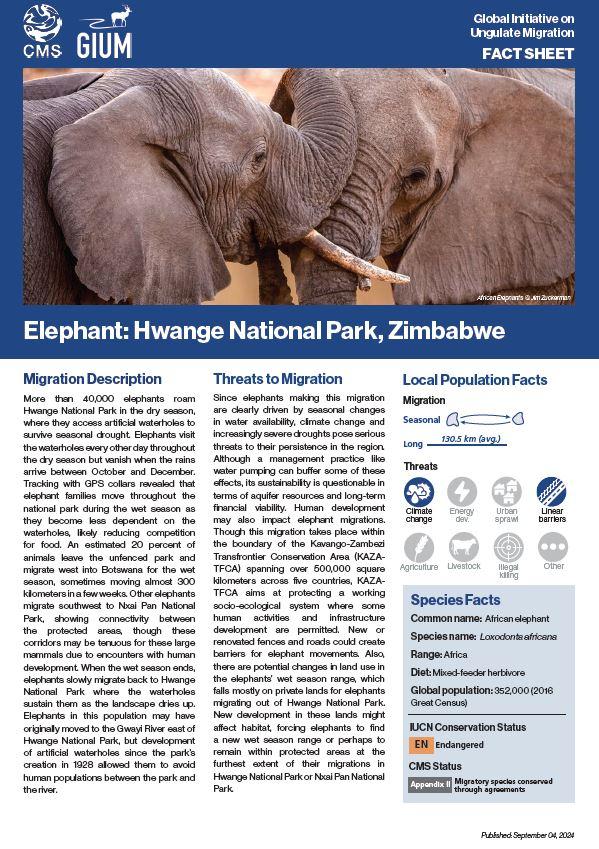
More than 40,000 elephants roam Hwange National Park in Zimbabwe in the dry season, where they access artificial waterholes to survive seasonal drought. Elephants visit the waterholes every other day throughout the dry season but vanish when the rains arrive between October and December. Tracking with GPS collars revealed that elephant families move throughout the national park during the wet season as they become less dependent on the waterholes, likely reducing competition for food. An estimated 20 percent of animals leave the unfenced park and migrate west into Botswana for the wet season, sometimes moving almost 300 kilometers in a few weeks. Other elephants migrate southwest to Nxai Pan National Park, showing connectivity between the protected areas, though these corridors may be tenuous for these large mammals due to encounters with human development. When the wet season ends, elephants slowly migrate back to Hwange National Park where the waterholes sustain them as the landscape dries up. Elephants in this population may have originally moved to the Gwayi River east of Hwange National Park, but development of artificial waterholes since the park’s creation in 1928 allowed them to avoid human populations between the park and the river.
Chad’s elephant population in Zakouma National Park in Chad suffered a dramatic decline from the 1970s to 2013, largely due to intense illegal killing by armed poachers from neighboring Sudan. Illegal killing declined after 2010 through a comprehensive law enforcement program initiated by African Parks, primarily for Zakouma National Park. Since then, the population has rebounded, now exceeding 550 individuals, making Zakouma home to one of Central Africa’s largest elephant herds. Though conservation and law enforcement efforts have successfully reduced illegal killing in Chad, elephants across West and Central Africa remain at risk of local extinction due to illegal killing and habitat loss. The poaching crisis was originally driven by the demand for ivory, however political instability in neighbouring countries may lead to increased or resumed illegal killing.