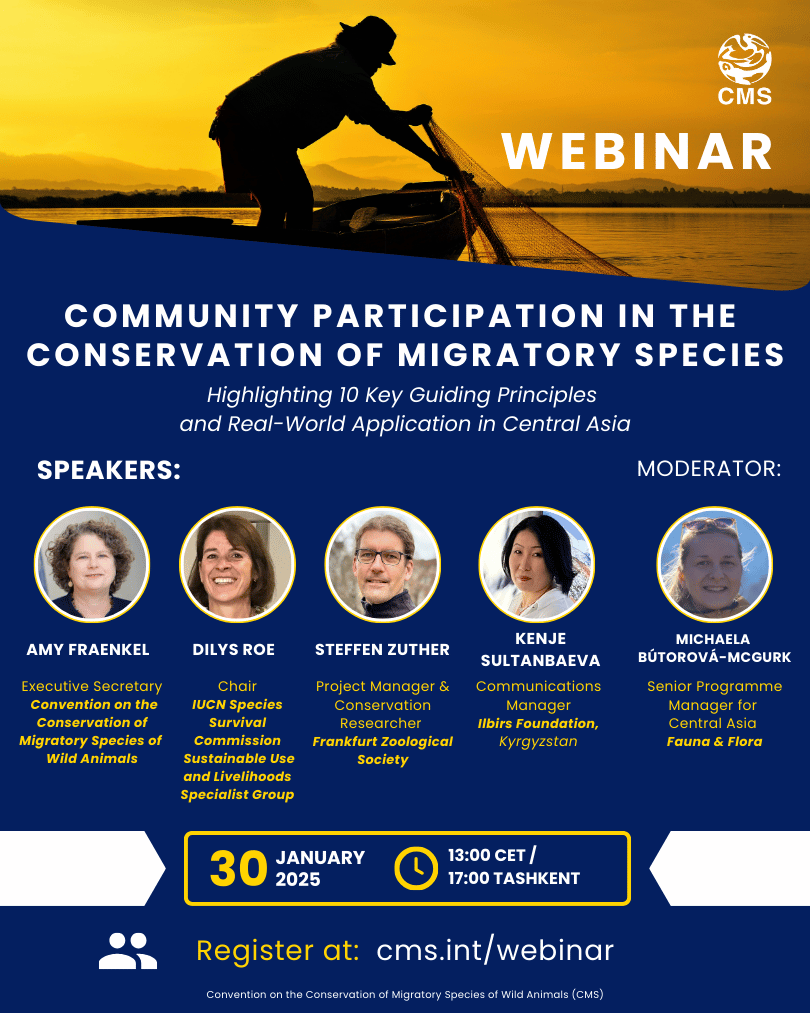
Highlighting 10 Guiding Principles for Community-Based Wildlife Management and Real-World application in Central Asia
Community-led conservation strategies can be instrumental for the successful conservation of migratory species according to two major reports to be released by the Convention on the Conservation of Migratory Species of Wild Animals (CMS), a global wildlife treaty of the United Nations.
The two studies — Community Participation and Livelihoods and Potential for Community-Based Wildlife Management in Central Asia — offer a novel set of 10 key guiding principles for involving communities in conservation strategies, as well as real-world insights into how community-led initiatives can balance biodiversity conservation with sustainable livelihoods and respect for community rights.
The ten principles have been synthesized from an analysis of 78 case studies from 50 countries involving 82 migratory species (39 terrestrial, 24 avian and 15 aquatic). The Central Asia study will showcase real-world application of the principles, highlighting innovative, practical and successful approaches for wildlife management in the region and beyond. It focuses on migratory species such as the Bukhara Deer, Saiga Antelope, Argali Sheep, and Snow Leopard in Kazakhstan, Kyrgyzstan, Mongolia, Tajikistan, and Uzbekistan.
Watch a recording below and learn about these new principles and discover key findings from their real-world use!
Acknowledgements: The Community Participation and Livelihoods study was prepared with support from the Joint Nature Conservation Committee (JNCC) of the United Kingdom of Great Britain and Northern Ireland. The Potential for Community-Based Wildlife Management in Central Asia (CAMI) study was prepared with support from the International Academy for Nature Conservation of the German Federal Agency for Nature Conservation (BfN INA) by the German Federal Ministry for the Environment, Nature Conservation, Nuclear Safety and Consumer Protection.
SPEAKERS
- Amy Fraenkel, Executive Secretary of the Convention on the Conservation of Migratory Species of Wild Animals
- Dilys Roe, Chair, IUCN Species Survival Commission Sustainable Use and Livelihoods Specialist Group
- Steffen Zuther, Project Manager and Conservation Researcher, Frankfurt Zoological Society
- Kenje Sultanbaeva, Communications Manager, Ilbirs Foundation
Moderated by:
- Michaela Bútorová-McGurk, Senior Programme Manager for Central Asia, Fauna & Flora
SPEAKER BIOS
Amy Fraenkel
Executive Secretary of the Convention on the Conservation of Migratory Species of Wild Animals
Amy Fraenkel has over 30 years of experience in international environmental law and policy. Before being appointed to lead the Convention on the Conservation of Migratory Species of Wild Animals (CMS) in 2019, she held senior roles in the Secretariat of the Convention on Biological Diversity (CBD) and the United Nations Environment Programme's Regional Office for North America. Prior to her UN work, she served as Senior Counsel for the U.S. Senate's Oceans, Atmosphere, Fisheries, and Coast Guard Subcommittee, overseeing legislation and policy related to climate change, ocean and coastal ecosystems, fisheries, endangered species, and maritime issues. She also worked as a senior policy advisor at the U.S. Environmental Protection Agency on issues related to chemical pollution and trade and the environment.
Dilys Roe
Chair, IUCN Species Survival Commission Sustainable Use and Livelihoods Specialist Group
Dr Dilys Roe is a principal researcher at the International Institute for Environment and Development (IIED) and leads the Institute’s work on biodiversity and conservation. She is also the Chair of the IUCN Sustainable Use and Livelihoods Specialist Group and Vice Chair of the Collaborative Partnership on Sustainable Wildlife Management. Her work focuses on human dimensions of conservation – including understanding and supporting the necessary conditions for effective community-based conservation and enhancing community voices in conservation policymaking – and on building the evidence base for the role of sustainable use of wild species as a key tool for supporting conservation and livelihoods.
Steffen Zuther
Project Manager and Conservation Researcher, Frankfurt Zoological Society
Steffen Zuther works as project manager and conservation researcher at the Frankfurt Zoological Society. Since 2007 he has taken on various roles related to the Altyn Dala Conservation Initiative in Kazakhstan (ADCI), a large-scale and long-term grassland ecosystem conservation initiative, having been based for many years at the Association for the Conservation of Biodiversity of Kazakhstan (ACBK). During this time, he has been involved in educational work, community awareness raising, land-use planning, support and coordination of rangers and a hunting area, research and extensive fieldwork activities. A lot of these tasks were related to the Saiga Antelope as one of the key species of the ADCI. As the species is prone to mass die-offs, he has also supported wildlife disease research and management. As the Saiga populations have grown significantly in recent years, causing conflicts with local people, his focus has recently shifted towards solving this conflict and supporting agencies in Kazakhstan in their first steps towards a system of sustainable use of Saiga.
Kenje Sultanbaeva
Communications Manager, Ilbirs Foundation, Kyrgyzstan
Kenzhekan Sultanbaeva is the Communications Manager for the Ilbirs Foundation, a local NGO in Kyrgyzstan dedicated to biodiversity conservation with a focus on snow leopard protection. In her role, Kenzhekan works closely with local communities to collect data and support their engagement in biodiversity conservation. She plays a key role in developing climate-smart livelihoods, such as beekeeping, ecotourism, and fruit plantations, to help diversify community income sources and reduce vulnerability to climate change impacts. Additionally, Kenzhekan is involved in human-wildlife conflict management and the establishment of community-based wildlife conservation organizations, working to strengthen both environmental and community resilience.
Michaela Bútorová-McGurk
Senior Programme Manager for Central Asia, Fauna & Flora
Michaela Bútorová-McGurk leads Fauna & Flora's conservation programme in Central Asia, with years of experience in managing species recovery and facilitating collaborative partnerships for nature restoration, including as part of the Altyn Dala Conservation Initiative in Kazakhstan. With background in sustainable development and international policy, Michaela has keen interest in supporting international cooperation and promoting mechanisms for more participatory, community-based conservation efforts across the region.