
Fact Sheet on Elk Migration
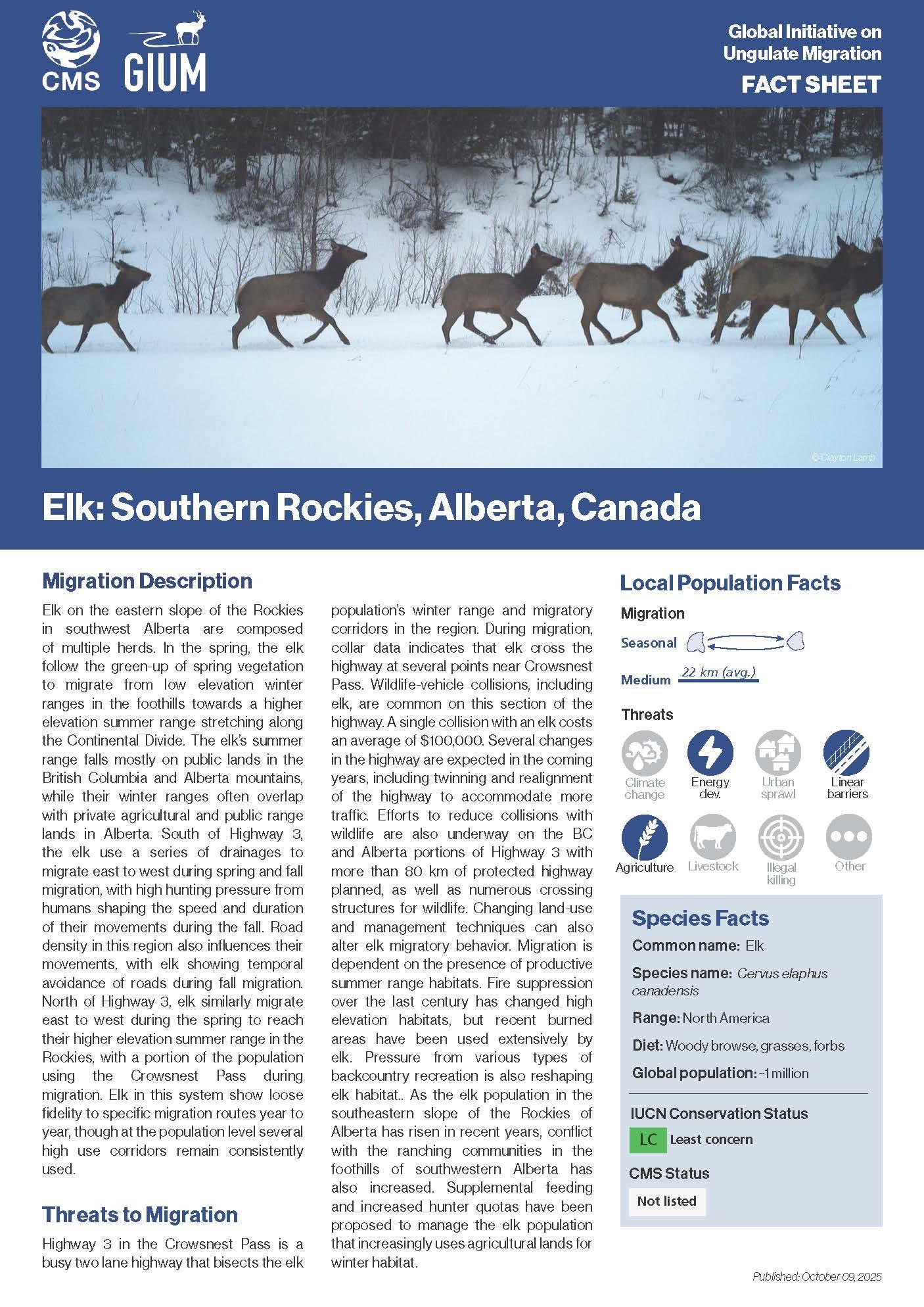
Southern Rockies, Alberta, Canada
Elk on the eastern slope of the Rockies in southwest Alberta are composed of multiple herds. In the spring, the elk follow the green-up of spring vegetation to migrate from low elevation winter ranges in the foothills towards a higher elevation summer range stretching along the Continental Divide. The elk’s summer range falls mostly on public lands in the British Columbia and Alberta mountains, while their winter ranges often overlap with private agricultural and public range lands in Alberta. South of Highway 3, the elk use a series of drainages to migrate east to west during spring and fall migration, with high hunting pressure from humans shaping the speed and duration of their movements during the fall. Road density in this region also influences their movements, with elk showing temporal avoidance of roads during fall migration. North of Highway 3, elk similarly migrate east to west during the spring to reach their higher elevation summer range in the Rockies, with a portion of the population using the Crowsnest Pass during migration. Elk in this system show loose fidelity to specific migration routes year to year, though at the population level several high use corridors remain consistently used.
Southern Rocky Mountain Trench, British Columbia, Canada
The elk population of the East Kootenay in southeastern British Columbia comprises a patchwork of subpopulations, with the greatest concentration in the southern Trench and Elk Valley. There, elk spend the winter along mountain valleys and in the river floodplains of the Kootenay and Columbia Rivers between the Purcell and Rocky Mountains and on productive grasslands in the Elk Valley. These populations are partially migratory and exhibit complex migratory behaviors. While residents and migrants share a winter range, in spring some individuals migrate while others remain on their winter range year-round. Migrants adopt two main behaviors, with some migrating longer distances at a lower elevation, and others performing elevational migrations, traveling shorter distances but with greater altitudinal gain. Thus, elk migrations in the Trench/Elk Valley can vary from a few kilometers to over 100 km. Elk migrating longer distances tend to travel along valleys, while elk migrating higher in elevation tend to have less linear movements as they travel up and down mountain slopes. Elk may change strategy year to year, shifting between making long, lower-elevation migrations to migrating shorter distances at higher elevations, and changing the amount of time spent on summer range. The start of migration for fall and spring can vary year to year, depending on the amount of snow on the ground.
| Fichier attaché | Taille |
|---|---|
| Fact Sheet on Elk Migration, Alberta, Canada | 1.88 Mo |
| Fact Sheet on Elk Migration, British Columbia, Canada | 2.02 Mo |