
Fact Sheet on Wild Camel Migration
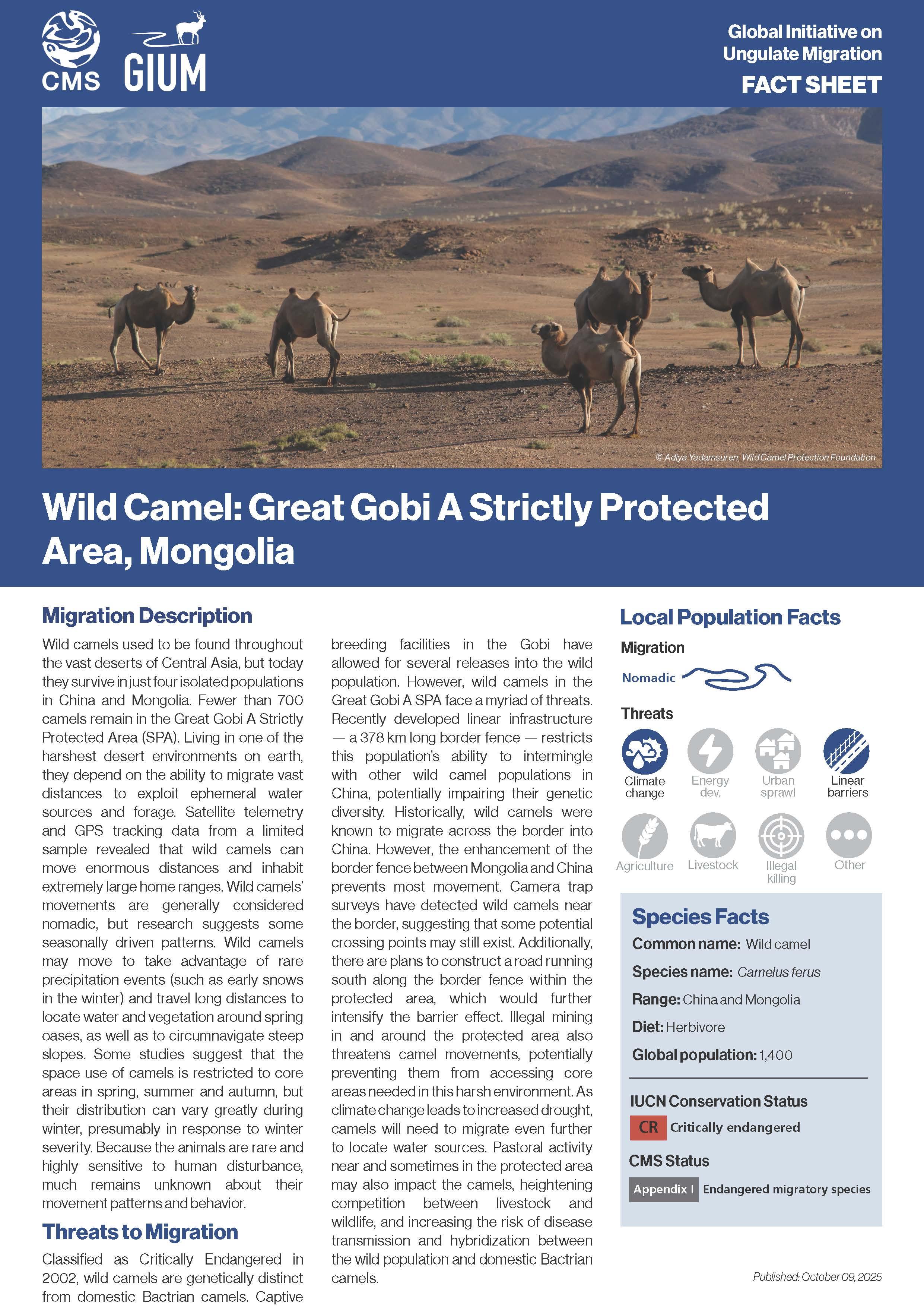
Wild camels used to be found throughout the vast deserts of Central Asia, but today they survive in just four isolated populations in China and Mongolia. Fewer than 700 camels remain in the Great Gobi A Strictly Protected Area (SPA). Living in one of the harshest desert environments on earth, they depend on the ability to migrate vast distances to exploit ephemeral water sources and forage. Satellite telemetry and GPS tracking data from a limited sample revealed that wild camels can move enormous distances and inhabit extremely large home ranges. Wild camels’ movements are generally considered nomadic, but research suggests some seasonally driven patterns. Wild camels may move to take advantage of rare precipitation events (such as early snows in the winter) and travel long distances to locate water and vegetation around spring oases, as well as to circumnavigate steep slopes. Some studies suggest that the space use of camels is restricted to core areas in spring, summer and autumn, but their distribution can vary greatly during winter, presumably in response to winter severity. Because the animals are rare and highly sensitive to human disturbance, much remains unknown about their movement patterns and behavior.
| Fichier attaché | Taille |
|---|---|
| Fact Sheet on Wild Camel Migration | 2.21 Mo |